Vet-Dop2
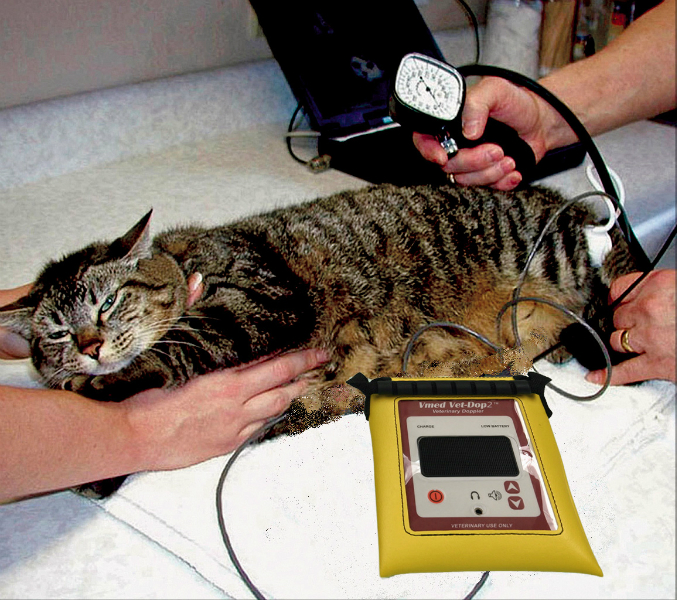
Veterinary Doppler blood pressure system. The Doppler of choice by experts in the field of veterinary blood pressure measurement.
Used to screen for hypertension, to check blood pressure in surgery, to monitor blood flow at the extremities during surgery and to check for intact blood vessels after trauma and before amputation.
The non-invasive Doppler technique is the preferred instrument for obtaining non-invasive, accurate systolic readings in animals weighing less than 15 pounds, especially cats. Other methods, including monitors that use the oscillometric technique, may not calculate pressures as quickly, especially on awake, smaller patients. The Vet-Dop2 also works well on larger breeds and can detect blood flow at the base of the tail in horses.
Features
- Easy to use and designed for veterinarians to measure Doppler systolic blood pressure
- Portable, rugged and reliable
- Advanced, low noise electronics provides clear blood flow audio through the built-in speaker. Stereo audio headphones that by-pass the speaker are included since speaker sounds may startle the animal.
- Rechargeable Lithium-ion battery with >35 hours between charges
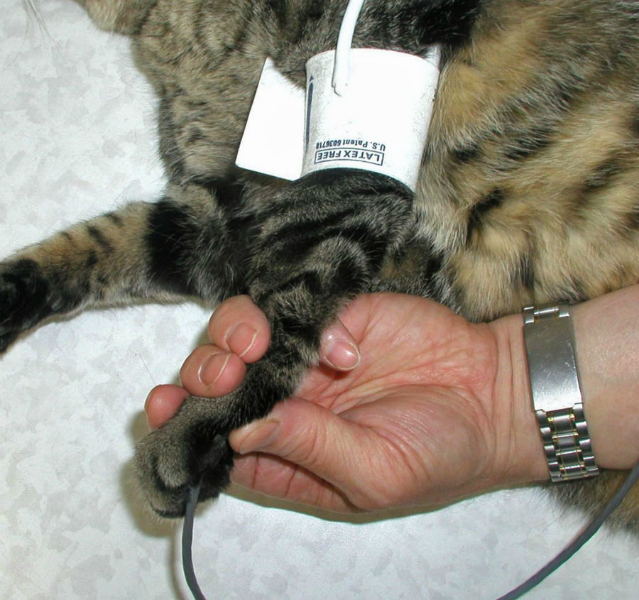
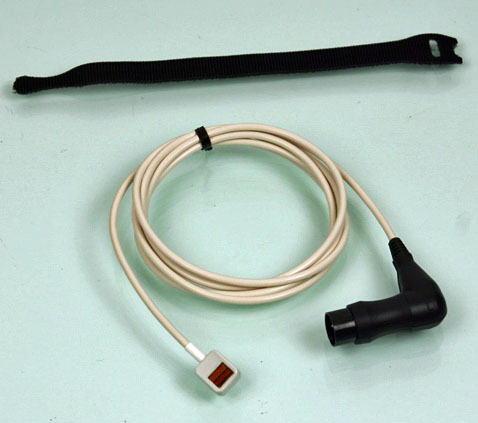
- Sensitive 9.4 MHz. focused transducer that can be held in place with the finger or thumb while steadying the limb with the same hand, or may be secured to the limb using one of the Velcro straps provided.
- Two year parts and labor warranty, six months for accessories
Accessories Included
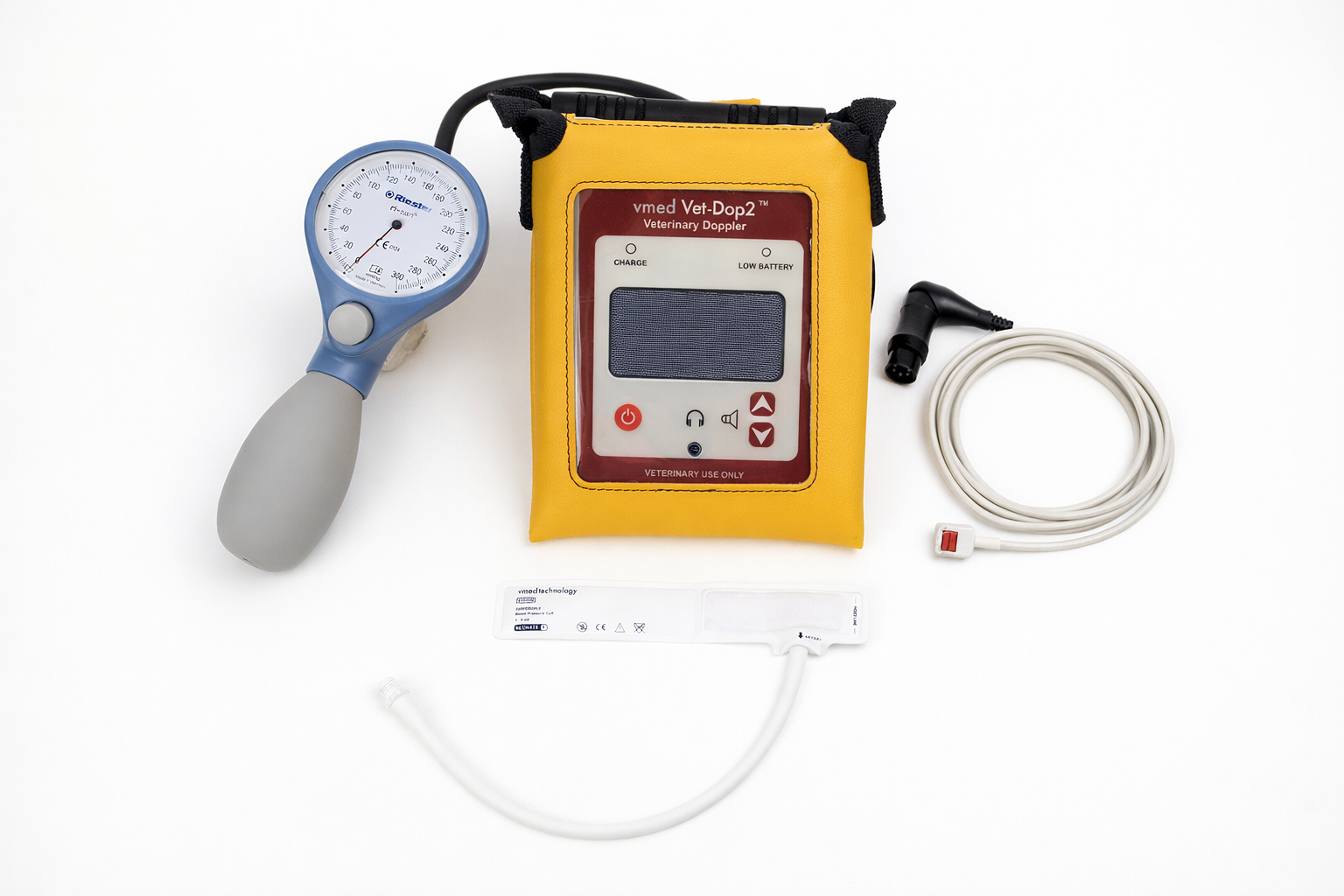
- Sphygmomanometer
- Set of 6 animal cuffs (cover limb circumferences from 3.3 to 16.8 cm – from small kittens to large dogs)
- Stereo audio headphones
- Storage pouch
- Protective carry pouch
- Doppler procedure and hypertension video on Vet-Dop application and clinical use
How To Use The VetDop2 Blood Pressure System
- To measure blood pressure you need the Vet-Dop to detect blood flow, a cuff inflator with gauge (sphygmomanometer) and a blood pressure cuff of the appropriate size. Ultrasound gel is also needed to ensure a good acoustic connection between the probe and the animal’s skin.
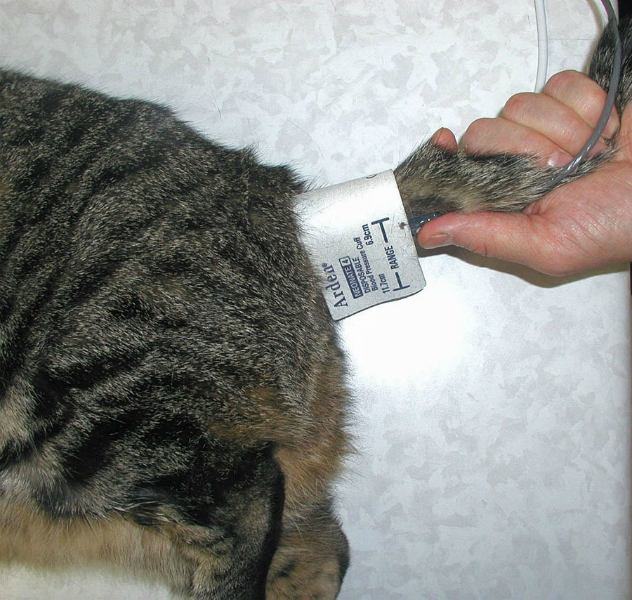
- The cuff width should be selected based on the limb size and should never be smaller than the diameter of the limb used but can be up to twice this diameter without affecting accuracy.
- The Doppler is placed distal to a cuff and is used like a stethoscope to detect the onset of blood flow as the cuff is deflated. Systolic pressure is read at this point on a pressure gauge.
- Accurate diastolic pressure is usually not detectable with Doppler, however because of the relatively broad band frequency response of the Vet-Dop, diastolic pressure is more likely to be detected.
- Some clinicians prefer to use a headset so the animal is not frightened by the Doppler signal although by keeping the volume low this may not be a problem.
Watch Dr. Norsworthy demonstrate a blood pressure measurement using the original Vet-DopTM
Indirect Blood Pressure Determination in Cats using Doppler Ultrasonic and Oscillometric Methods
“Blood pressure measurements obtained using Doppler ultrasonic flow meter and an oscillometric device in 11 conscious cats were compared. Systolic blood pressure was not significantly different from each other (p<0.05) within a range from 100 to 150 mmHg (Doppler) rsp. 101 to 154 mmHg (oscillometric device) using cuffs with a width 41.2% rsp 44.3% the limb circumference. The oscillometric device failed when blood pressure was low, it required more time to obtain readings and measurements were less consistent compared to the Doppler technique. The Doppler flow meter detected a pulse under all conditions and readings were hardly influenced by movement in contrast to the oscillometric device.” A Mollenhoff, I Nolte, S Kramer, Univ Leipzig, Fak Vet Med, Klin Kleintiere, Tierkliniken 23, D-04103 Leipzig, Germany. Tierarzliche Praxis Ausgabe Kleintiere Heimtiere, 2001, Vol 29, Iss 3 pp 191-197:
Using the Doppler as a Surgical Monitoring Device
“Doppler flow technology presents several desirable characteristics over other monitoring devices as a surgical monitoring device. The ability of the Doppler to measure blood flow in a peripheral artery and generate an audible sound with each pulse provides the surgeon with an ‘eyes free’ way to evaluate their patient’s cardiovascular performance while continuing to focus on their surgery. If the peripheral Doppler sound is good, the systolic blood pressure is within an acceptable range, and with a sphygmomanometer above the Doppler transducer, the systolic pressure can be easily and economically measured and entered into the anesthetic record. Although diastolic pressure cannot be measured this way, the reliability of Doppler blood pressure monitoring allows the anesthetist to spend less time fiddling with the monitor and more time monitoring the patient. Heart rate can also be monitored audibly and recorded. A particularly strong value of the Doppler is the ability of the anesthetist or surgeon to hear ventricular premature contractions (the most common arrhythmia under anesthesia) as a ‘dropped sound’ in and otherwise stable, rhythmic ‘whoosh, whoosh, whoosh’; often in plenty of time to look up at the ECG tracing and watch the VPC go by on the screen! Supplemental ventilation of these patients will often resolve this common arrhythmia. Because the Doppler is portable, it can be moved with the patient easily when moving to radiology or the recovery area. Their low cost relative to other monitoring devices, reliability and toughness make them the best ‘bang for the buck’ surgical monitoring device in many people’s opinion.” R. Randy Bassinger, DVM, ACVS, South Carolina Veterinary Referral Center, Columbia, SC