VetChek
Wireless ECG and recovery monitor providing Lead II ECG, ECG respiration and temperature.
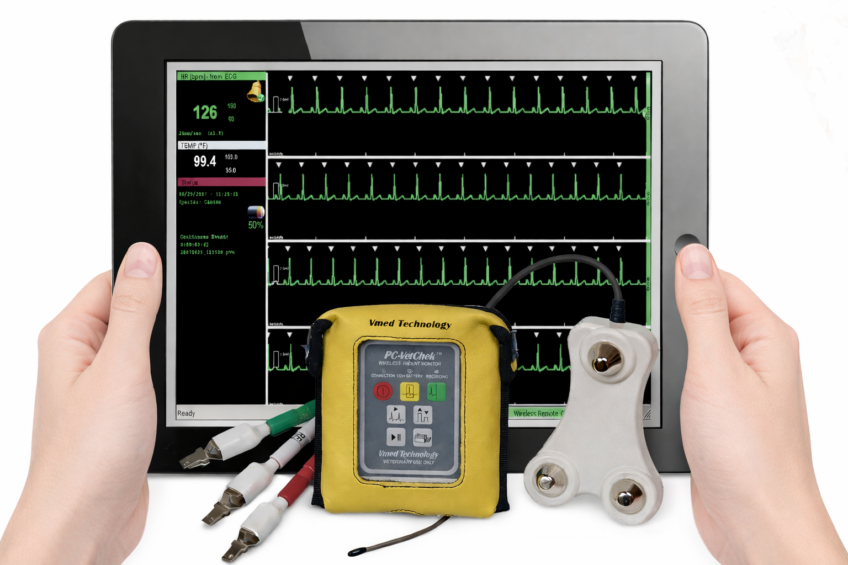
Eliminate clutter with the miniature wireless ECG, respiration and temperature monitor. Simply install software and plug the miniature Bluetooth adapter into your USB port.
Displays ECG and respiration waveforms, heart rate, respiration rate and temperature. Select chart speed, gain, grid, R-wave markers, beat tone and more.
Use in exam room, surgery and recovery* for diagnostic ECG and pre-surgical screens.
*”The postoperative period was the most common time for dogs, cats and rabbits to die usually within three hours of surgery…greater patient monitoring and management during this time period is recommended.” –The risk of death: The Confidential Enquiry into Small Animal Perioperative Fatalities, Brodbelt, et al., Veterinary Anaesthetics and Analgesia, 2008, 35, 365-373. Post-surgical deaths.pdf
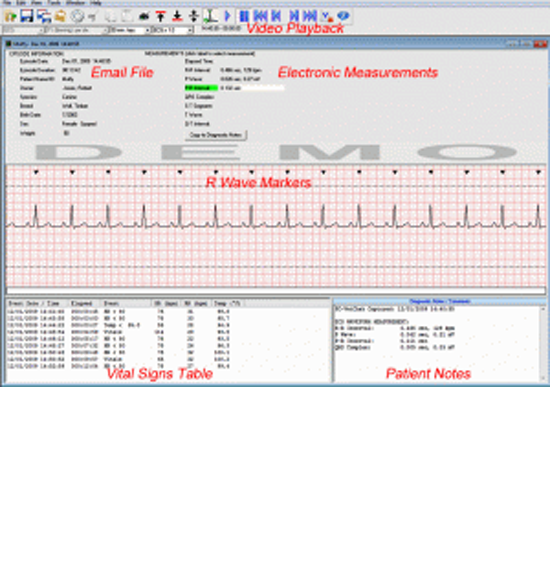
Wireless Bluetooth technology allows you to link to your Windows desktop, laptop or tablet computer to display real-time patient monitoring waveforms and digital data on your computer screen. Monitor up to seven patients on one computer. Files may be retrieved for waveform analysis, transmission via email or printed in a concise report.
Features
- Omnidirectional and virtually interference free wireless connection eliminates troublesome wires and bulky equipment
- Most control functions including printing available from the patient’s side
- Programmable alarms can be set for High/Low heart rate and Low temperature
- Tracks heart rate to 800 beats/min and provides trend graph
- Automatic storage of vital signs and ECG waveforms
- Email ECG files (native or pdf) to third parties
- Print ECG files remote from device to your computer
- Track the status of multiple patients on a remote central computer with as many as seven monitors on a single computer
- Protective hanging pouch provides a convenient attachment to kennel or surgery table
- Uses 2 AA batteries for 42 hours of battery life
Accessories Included
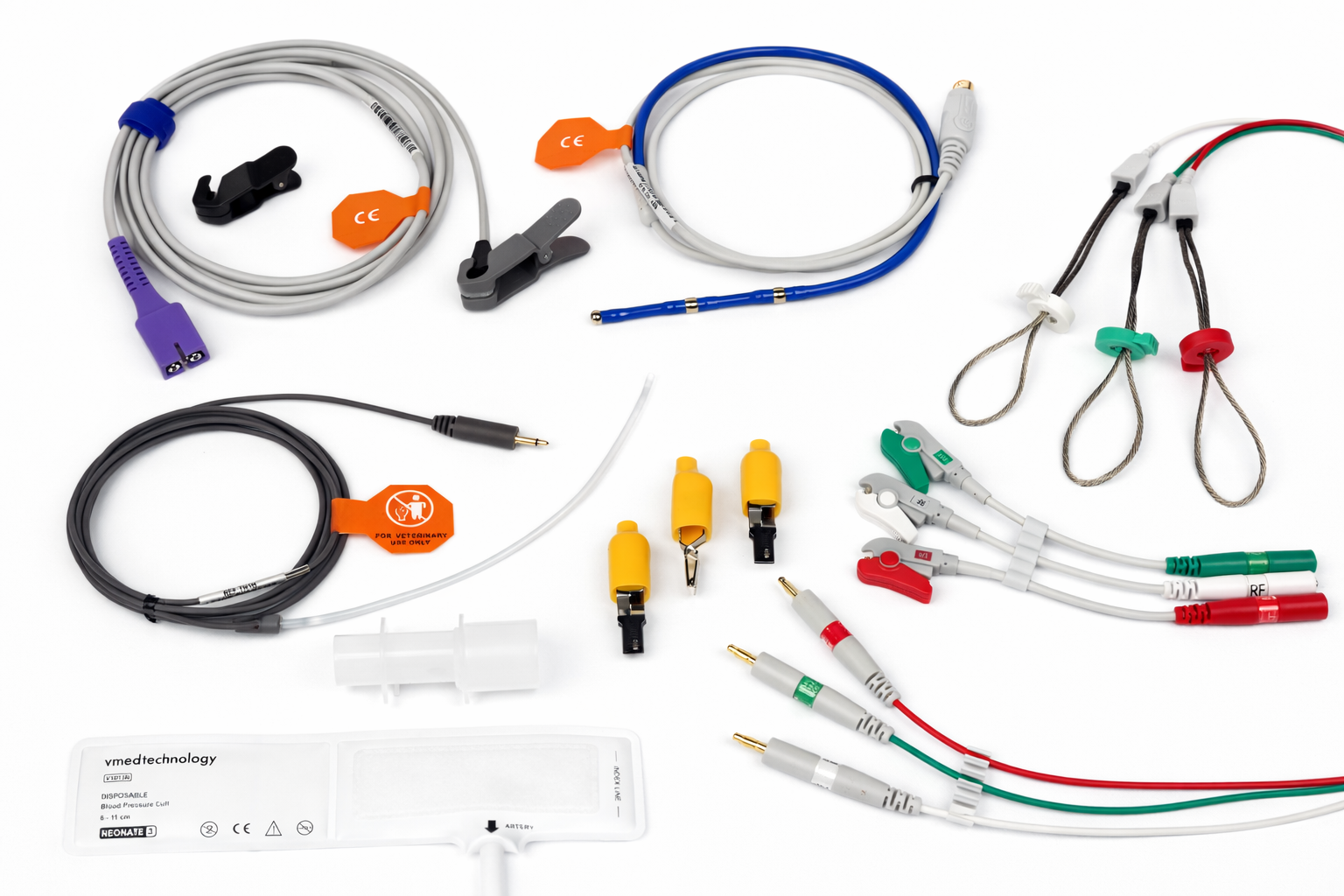
- Low force ECG skin clips
- ECG chest probe
- Temperature probe
- Bluetooth USB device
- PC-Display software
- ECG Reviewer software
- ECG interpretation software
Optional Accessories
- Esophageal ECG and temperature probes
- Long term monitoring electrodes
- ECG leg loops
- ECG needle electrodes
The VetChek can be used in the exam room to screen for heart abnormalities that may cause problems before, during and after surgery. ECG screens add value to the initial and subsequent annual exam and often allow the practitioner to find defects that support follow on care. Dr. Larry Tilley, a cardiology consultant, states that no other diagnostic test, including ultrasound, can accurately determine the source of various arrhythmias and conduction abnormalities as is done with ECG testing. Lead II is all that is needed in most cases; you can do away with complex lead analysis, axis shifts and perfect positioning of the pet. “The majority of veterinarians can interpret their own ECG by simply focusing on the heart rate and the cardiac rhythm.” For difficult cases, the ECG printout can be emailed directly to cardiology-based services for quick and inexpensive interpretations to determine the necessary course of action. The handy contoured chest probe makes exam room ECGs a snap. By simply placing the probe over the chest wall, the three built-in electrodes produce a quick, clean signal. The fear of the animal patient getting tangled in wires and cables is no longer an issue either. A modest procedure charge provides excellent investment payback.
Artifact suppression and low noise electronics offer the cleanest, most readable ECG trace possible. When this quality is combined with a virtually interference-free wireless connection to your computer, the result is an ECG system with a large screen display that can be easily seen from across the room. ECG rhythm strips are a snap with the unique Vmed chest sensor or use the included low force skin clips for diagnostic quality traces. ECG information, including clinic and patient identification, ECG trace, heart rate, chart speed, gain, etc. can all be displayed, saved to a file and stored on your computer without the hassle of downloading, all from the battery-operated, hand-held unit. (See the clinical papers page for a description of hand-held ECG in veterinary practices). Available with or without ECG interpretation software.
“The majority of veterinarians can interpret their own ECG’s by just simply focusing on the heart rate and what is the actual rhythm-using just one lead such as Lead II. All the other leads are used for mean electrical axis along with the size of the complexes which sometimes can help to determine heart chamber enlargement, but usually not accurate. The best way to determine heart enlargement in animals is with a chest X-ray or echocardiogram.” Larry Tilley, DVM, DACVIM
“ECG’s have been under-utilized in most veterinary practices. With the advent of new hand-held ECG screeners and monitors, and the simplification of interpreting results, ECG screening should become a standard component of wellness exams and pre-anesthesia procedures, just as in human medicine”. The Business of Veterinary Medicine, Steve May, Editor
“Cardiomyopathy can be diagnosed up to 2 years before becoming clinically evident by finding VPC’s on the Lead II ECG according to a recent report”. R.E. Whitford, DVM
“Every practice needs two ECG machines, an ECG screener in the exam room and an ECG monitor in the surgical room. No other diagnostic test can accurately determine the source of various arrhythmias and conduction abnormalities as the ECG”. Larry Tilley, DVM, DACVIM
“I find an ECG abnormality or an audible murmur on auscultation in about 1 out of 25 seemingly healthy cats.” Gary D. Norsworthy, DVM, DAPVP
Use in surgery for ECG, temperature and respiration monitoring
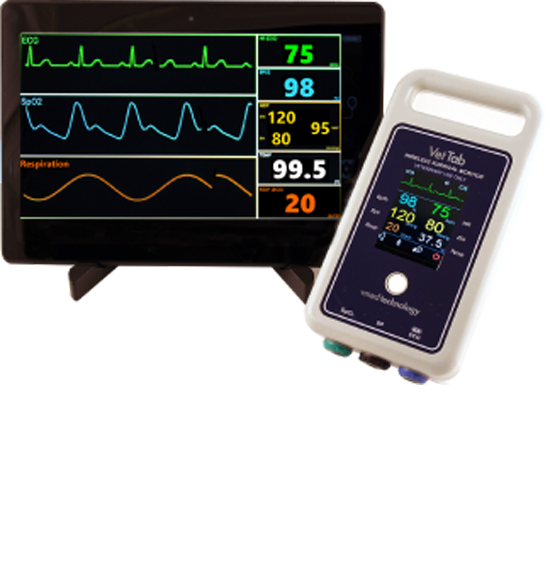
For surgery monitoring the VetChek, when used with an optional esophageal probe, becomes a large screen patient monitor displaying digital heart rate, respiration rate, temperature as well as ECG and respiration waveforms. Fully programmable alarms and other settings are available in the PC-Display software. A protective hanging pouch can be mounted on the surgery table, accessory cart or IV pole. Bothersome monitoring wires and cables are no longer an issue in surgery.
Compatible with Windows XP through Windows 10.
Please read this if you have or are considering using a Microsoft Surface Pro tablet with your Vmed device.